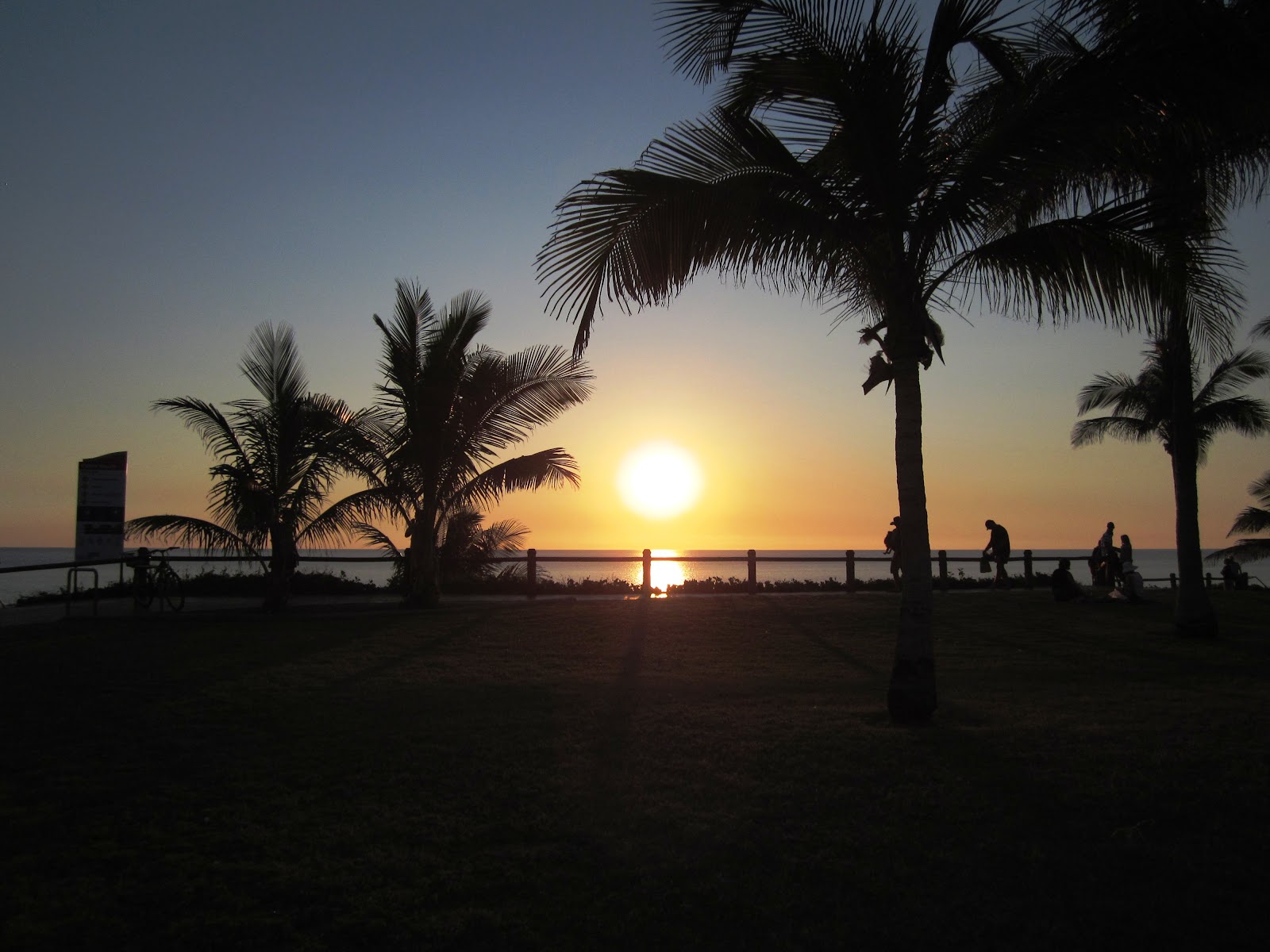
Saturday, July 14, 2012

Shark Bay area

Thursday, 28 June 2012 to Friday, 29 June 2012

We chose to stay at Hamelin Station Stay, a working sheep station about 100kms from Denham. They have a great caravan, camping area which is only a couple of kilometres from Hamelin Pool where some very rare and interesting stromatolites can be viewed. The stromatolites are a very simple life form which grows very, very slowly in extremely salty water. Last year we saw thrombolites at Lake Clifton in the south of Western Australia and discovered the difference is only that stromatolites grown in tidal water and thrombolites grow in the still water of lakes.
Stromatolites, Hamelin Pool, WA
Shell Beach, WA
5.30pm is "Happy Hour" in the camp kitchen/entertainment area, complete with a great fire if required.
Shell Beach, WA
The next day we drove towards Denham and our first stop was at Shell Beach which is created by millions of tiny shells, Fragum cockles, that grow in profusion in L'Haridon Bight where the beach is located.
Some of the shells have over time been cemented together by a chemical process between salt and calcium breakdown and this creates a very solid rock like substance which has been quarried for many years and used to build many of the original buildings in the area.

Shark Bay, WA
We continued on to several beaches and cliff lookouts around Shark Bay. Shark Bay is actually a series of bays and is most famous for being the first known area of the Australian mainland to be visited by Europeans in the early 1600's. The coast is very rugged and is the site of many shipwrecks. The coastline is very beautiful with crystal clear water that varies from light to dark blue and is dotted with many small islands. We then paid a visit to Monkey Mia but were too late to see the feeding of the dolphins as this now happens at about 7.45am only each day. Some of the dolphins still come back in at approximately 12.30pm but they don't get fed. We saw some of them but they don't stay very long when they realise they aren't getting any food. They played around in the shallow water for quite some time and then moved back out into the deeper water to feed.

Denham is a small seaside town, very popular with fishing enthusiasts.

Saturday, 30 June 2012

Murchison River, near Kalbarri, WA
We left Hamelin Station Stay and travelled south to Murchison River Rest Area where we found a very pretty area on the bank of the river. This proved to be a great place to take photos as there was a billabong and as the sun began to set we got some great shadows and reflections.

Kalbarri, WA
Kalbarri, WA
Kalbarri, WA

Nature's Window, Kalbarri, WA
Kalbarri has some spectacular gorges and rock formations, a pretty harbour area were the Murchison River meets the Indian Ocean and some beautifully rugged coastline. While in Kalbarri we also visited a parrot and bird breeding centre where we saw some very colourful and unusual birds.

Wednesday, 4 July 2012

Today we continued our trip towards Perth, our first stop being at Port Gregory. This is a very small fishing town with a huge salt lake which appears pink due to the beta carotene which grows in the salty water and is harvested for use in the food and health food industry.
Convict Ruins, WA

Pink Lake, near Port Gregory, WA

Northampton, WA

Banksia, WA

Sturt's Desert Pea, WA
A little further down the road we saw the remains of an old convict trading station used in the 1850's. We also visited Northampton, a quaint old Cornish mining town with a winding main street complete with many original shops. After a couple of roadside rest area sleepovers where we saw several wildflowers just starting to flower, we visited Gin Gin before completing our trip to Perth.

Wednesday, July 4, 2012

Carnarvon Area

Friday, 22 June 2012

Today we found our way to Point Quobba, 70kms north of Carnarvon. This is a typical beach camp, no amenities except a very crude dump point and camp sites nestled in between sand dunes. The camp caretaker showed Graham a site that we would fit into and after setting up we visited the 'Blow Holes'. The blow holes lived up to their name and the cliffs and rocks in this area are very spectacular. While here we witnessed balloon fishing, where the line is supported by a helium filled balloon over the water, the bait dangles below and the Spanish Mackerel jump up to grab the bait. Another attraction of this area is the 'aquarium', a shallow bay where small colourful fish swim around your feet and legs. It is advisable to bury your feet in the sand otherwise the fish will suck your toes.
Cliffs at Point Quobba, WA
Blow Holes, Point Quobba, WA
 Sunday, 24 June 2012

We spent a few days in Carnarvon, visiting the One Mile Jetty where a quaint little Coffee Pot train ferries tourists to the end of the jetty. We chose to walk and view the crabs and fish in the mangroves below. This jetty was the first in Australia to load livestock on ships for transport to markets.
Carnarvon, like many coastal town in the north of Western Australia, had a tramway which in the late 1800's and early 1900's transported goods to and from the jetty. The trams were originally horse drawn but were replaced by steam. This area has been a large sheep producing area and has a Shearing Hall of Fame which proved to be very interesting.
Carnarvon is also well known for the OTC dish which played an important part in the tracking of the moon landing mission in 1969 and Halley's Comet in 1987. It is not used these days but was recently opened as a tourist attraction by Buzz Aldrin, one of the US astronauts to visit the moon. The Gascoyne River, which runs into the sea at Carnarvon, looks to be dry most of the time but the water is stored in an underground aquifer which supplies the town with great fresh water.

Karratha, Dampier and a bit further

Wednesday, 13 June 2012

We were on the road again today heading to Roebourne, Karratha and Dampier. Roebourne caravan park was the only park with vacancies as all the parks in Karratha and Dampier are filled with mining industry workers. Roebourne has many old buildings including the Old Gaol which now days houses the Visitors Centre.
Old Building at Cossack, WA
Cossack is also another very old town in this area with a lot of old buildings but it is almost a ghost town with only the tourist trade to keep it going.

Dampier is named after William Dampier, explorer, who was one of the first Europeans to visit Australia. The town is best known for it's development by Pilbara Mining Company in the 1960's as an iron ore loading facility. Now days it is also known for it's salt production facility and Woodside Liquid Gas production plant. The North West Shelf Project Visitor's Centre provided us with a great overview of Australia's largest liquefied natural gas production plant.
Liquid Gas plant, Dampier, WA

"Red Dog", Dampier, WA
Dampier was also the home area for "Red Dog", a dog well known in this area in the 1970's and about which a movie was recently made. A statue at the entrance to town commemorates the bond between this dog and his master.


We also took a bus tour of the Rio Tinto iron ore facility which provided great information about the mining industry.
Iron ore train, Karratha, WA
Iron ore loading facility, Karratha, WA


Sunday, 17 June 2012
Exmouth was our destination today. Along the way, known as the "Wool wagon Pathway" we encountered the first sheep since leaving South Australia. Exmouth is on a peninsular, mostly national park land and has many great beaches and gorges to view and explore.
We drove to Charles Knife Road Canyon where you can look down into the canyon below. After lunch at Pebble Beach, so named because it consists of millions of pebbles of varying colours and shapes, we drove through Shot hole Canyon and viewed the towering cliffs around us. This canyon was named because of the shot holes left there after explosions during oil searches in the 1950's. The layers of rock changed from pale cream to yellow and then to dark reds and browns. We met a couple of geologists who had found a piece of rock with sea shells embedded between the layers. This rock layer was hundreds of feet below the rim of the gorge, a remainder of the inland sea which once covered much of the land.
Charles Knife Canyon, near Exmouth, WA
Yardie Creek Gorge, near Exmouth, WA
Yardie Creek Gorge was also very pretty. Here we saw, kangaroos and Black Faced Rock Wallabies. The wallabies are very hard to see as they live on ledges in the rocks and their colouring is very similar to that of the rocks.
Smallest Airline terminal, near Exmouth, WA

The highlight of the stay was our trip on a glass bottomed boat to the Ningaloo Reef to view the coral and beautiful fish. We also were able to snorkel around the boat for the best part of an hour. We also saw large turtles in the water and fortunately no sharks. The Ningaloo Reef is breathtakingly beautiful.


Other interesting sites around Exmouth are the "Mildura" shipwreck, a cattle ship which sank near the coast in 1907, and the E H Holt Communications Base, set up by the US government during the 'cold war' in the 1960's to provide communication with submarines all around the globe, even underwater. The base is still guarded by the Australian Federal Police.

Wednesday, June 27, 2012

Moving Southward

Saturday, 2 June 2012
The "Mini Pinnacles"
Beach at Barn Hill Station Stay


Rocks at Barn Hill

Barn Hill Station Stay was our destination today. Situated on Thango Station, a working cattle station of approximately 43,000 acres, stretching 85km along the coast between Broome and Port Hedland and running 8000 head of Brahman cattle, the campsite is a little oasis for travellers. There is a small shop/office and a real "lawn" bowling green, 'well it is grass', and they put on a great 3 course roast dinner on Sunday nights for $15 per head plus entertainment which anyone can join-in with, if they can, and dancing is encouraged. We all took our own chairs, tables, crockery, cutlery and drinks and they served about 150 meals and we all had a great time. The power situation is very limited and you pay for what you get, none of it will run anything with a heating element. We chose no power. The ammenities blocks have no roofs but do have hot water, some provided by black poly pipe lying on the ground during the day. Frogs were common in the toilets and they attract snakes but we were fortunate not to encounter any of the snakes. The view of the beach and ocean is brilliant and the rock formations, known as the "Mini Pinnacles" are great. We tried fishing without success but we did see dolphins swimming in the area so that ended the fishing excercise.

Thursday, 7 June 2012

Cape Keraudren campsite was our destination today after a 12km rough gravel road trip from the main road. There is not much at this campsite, no power, no water and not much beach. The men decided that it wasn't worth trying to fish in this area so we had a couple of quiet days before we moved on to Port Hedland.

Saturday, 9 June 2012
Port Hedland Golf Club was our resting area as all caravan parks were booked out by mine workers or the early travellers. The amenities in the club house were good and we stayed for a few days. Port Hedland isn't the prettiest town in the country but it could be described as interesting. The whole town is covered in a layer of red dust from the iron ore mining operations in the area and as most of the housing is occupied by the mining industry workers who won't be in the town for many years and don't own the houses, many are in need of some tender loving care.
Iron Ore Loading facility
Iron Ore Train
Port Hedland has a large port area for loading ships with iron ore and salt. There is a huge salt production plant where sea water is pumped into large ponds, dried naturally by the sun and then scraped into piles and loaded onto trucks before being loaded onto the ships. The iron ore is transported to the port by very long trains, up to 220 trucks and several kilometres long.
Salt Stock Pile
Iron Ore Ship


Monday, June 18, 2012

Broome, WA

Thursday 24 May to Friday 1 June 2012

We arrived in Broome just before lunch and booked into Tarangau Caravan Park, managed by Bevan & Lorraine Reid from Temora. It was starting to look like a back to Temora week at the park as there were several other couples from Temora there. We had a great night at a sausage sizzle fundraiser for the RFDS at the park BBQ area. One of the park regulars sang and told a few jokes and anyone who could perform was welcome to join in.

On Friday we had a look around the town, lots of pearl shops and many houses built with corrugated iron. Some of these houses are valued at 1 million dollars or more. They are no doubt very nice inside but all look much the same from the outside, with varying shades of grey corrugated iron on the roofs and walls.

Shops in Broome, WA

The old town area is very plain in appearance and obviously designed to withstand the cyclones that hit this area. Broome has a port area with a long jetty where large ships dock to load cattle for the live export market in Asia and the middle east. Broome also has very high tides so the jetties are very long and high. We also took a tour around town on a red double decker bus from which we could see some of the most interesting parts of Broome.
Broome still has an operating open air movie theatre complete with deck chairs.

Cable Beach at sunset, Broome, WA
Cable Beach, Broome, Wa
A visit to the museum proved to be very interesting. We spent a couple of hours there one afternoon and at closing time we hadn't seen it all so they said we were welcome to come back free of charge within the next week to finish the tour. This museum is particularly interesting because of the many different areas that it covers, from the aboriginal history, the pearling industry including the aboriginal and asian workforce, the cyclones, World War II bombings and the cattle industry.

Other interesting sites in the Broome area are Dampier's Chest, the story says William Dampier, the explorer, buried treasure in the area but it has never been found, and the Chinese and Japanese cemeteries. As usual, the chinese ran the market gardens and many of the shops in the town and the japanese and other asians were particularly skilled in the pearling industry.


Cable Beach, possibly Broome's most famous attraction is interesting, with the camel rides and photo opportunities at sunset being the main tourist attraction.

Wednesday, May 30, 2012

Derby, WA

High Tide, Derby, WA
Tuesday, 22 May 2012 to Wednesday, 23 May 2012

Derby was our destination today. Derby has incredibly high tides ranging from low tide of 1.86 to 11.5 metres at high tide and ranks amongst the nine highest tides in the world. The water looked like liquid chocolate as the flood water entering from the Fitzroy River is very muddy. We were lucky enough to see the tide change on Wednesday morning and the dirty water made this very easy.
Low Tide, Derby, WA

We also visited the Old Derby Gaol, a covered caged area which was used to hold aboriginals in atrocious conditions.
Our next stop was Myall's Bore and Cattle Trough which is 120 metres long and could handle 500 bullocks at one time.

The Prison Boab Tree is believed to be about 1500 years old. It is hollow in the middle and was used to hold mainly aboriginal prisoners or those captured for slave labour for a night on their way to Derby.
Prison Boab Tree, Derby, WA
Myall's Water Trough, Derby, WA
Fonty's Pool, built in 1944 as a bathing pool for the troops stationed in the area is alongside the road into Derby.
It is very small and was used by the officers for part of the day and the non-coms had use of it at other times. Derby played a significant part in the Second World War and was bombed by the Japanese several times.

Tuesday, May 29, 2012

Bungle Bungles

Friday, 18 May 2012

We left Kununurra this morning and headed south to Spring Creek Rest Area where we decided to camp for two nights as it is close to the road into Purnululu National Park where the Bungle Bungles can be explored. The road south is part of Highway One and has a surprising number of one lane bridges which cross several rivers including Bow River.

Saturday, 19 May 2012

Bungle Bungles, WA
Bungle Bungles, WA

Bungle Bungles, WA
We decided on a very early start, about 5.45am as the drive into the Bungle Bungles is only about 56kms but because of the rough and corrugated road takes a couple of hours to travel. After registering at the ranger station we had another 45 minute (27kms) drive to Piccaninny Creek car park before we commenced our first walk to explore the famous "beehive domes" and the Cathedral Gorge. This area is, in my opinion, more spectacular when viewed from the ground than from the air. Words cannot describe the beauty and wonder of this area.
After lunch we commenced our next drive to Echidna Chasm approximately 20kms in the other direction. There are many gorges and chasms to view but we only had time for two. We first walked along a very rocky path then entered the chasm with it's incredibly high walls and the light streaming in from the top intensified the colours of the rocks. The chasm is only one person wide in some parts and quite steep towards the end.
We then returned to the cars and commenced our return trip to our campsite before dark.

Echidna Chasm, Bungle Bungles

Sunday, 20 May 2012

After our early start and long walks yesterday, we set off a little later this morning and travelled in a very spread out convoy. We had a stop at Halls Creek for morning tea and a visit to the visitor centre. We spent the night at Mary Pool Rest Area on the Mary River.

Monday, 21 may 2012

Today was another travelling day with a stop at Fitzroy Crossing for fuel before we moved on to Ellendale Rest Area while the other couples went to view Geikie Gorge but without success as the going was a bit too rough and sandy.

Sunday, May 27, 2012

Kununurra, WA

Monday, 14 May 2012

Mirima National Park, Kununurra, WA
This morning we visited Mirima National Park, known as Happy Valley, which adjoins our caravan park. This area is sometimes referred to as the Little Bungle Bungles. Next we travelled about 13kms from Kununurra to visit the Sandalwood Factory where we learnt that in the next few years over 80,000 hectares of land will be planted with sandalwood. Sandalwood trees need a host tree to live on and they are planted with two other varieties of trees, one that grows quickly but doesn't live more than 5 to 6 years and another that will take over as host when the first host tree dies.
A little further down the road is the "Hoochery", the only remaining sugar cane growing property in the area and the sugar is used for the making of rum.
Crawf had a few samples before buying a bottle of rum liqueur.
Zebra Rock
Our next stop, with me as driver, was on the other side of town at the Zebra Rock Gallery. This area has the only known deposits of Zebra Rock in the world. The rock when cut has beautiful stripes and colours.


Tuesday, 15 May 2012
Zebedee Springs, El Questro, WA 

Emma Gorge, El Questro, WA
Today's excursion was to El Questro, outback playground of the rich and famous and also those who just want to have a day trip to see this lovely wilderness area. The resort is very expensive and we didn't go anywhere near it. We stopped at the Emma Gorge ranger station and purchased our permits then continued to Zebedee Springs where we found a lovely thermal pool with a small waterfall. We all enjoyed a swim before lunch then returned to Emma Gorge for a challenging walk and climb. As it was getting late most of us decided to enjoy a lovely waterhole about 2/3rds of the way along the walk. Three of the men continued to the top and took some photos but as the gorge is very deep and it gets dark very early here, we were struggling to get back to Kununurra before dark.

Wednesday, 16 May 2012

5.15am - We were picked-up by the bus at our caravan park and taken to our plane for a flight over the Bungle Bungles. As I had never flown before the pilot suggested that as one passenger had to sit up the front with him that it might be a good seat for me. It was great.

We witnessed sunrise over Lake Argyle then continued for breathtaking views of the Bungle Bungles. After several passes over the magnificent rock formations we returned to Kununurra via the Argyle Diamond Mine which is the world's largest supplier of diamonds, producing approximately 30 million carats each year.  Rare pink diamonds are found in this area. After our two hour trip we were delivered back to our park.
Sue's View, flight over Bungle Bungles
Argyle Diamond Mine, WA
 The afternoon was spent, by some, trying to catch fish at Ivanhoe Crossing just out of town but without any success. The crossing is closed at the moment to road traffic because of the huge amount of water being released from Lake Argyle into the Ord River system for irrigation.

Across the Top End

Tuesday, 8 May 2012

We left Victoria River mid-morning and stopped at Timber Creek to look around and check our phone calls. Next stop was at Big Horse Campsite but after a quick walk around check we decided that there wasn't enough room for us so we continued until we found Saddle Creek Rest Area. We met some more interesting people and although we were surrounded by burning off fires in the hills and valleys in the area we settled down for another very warm night.

Wednesday, 9 May 2012

The fires burning in the area created a lot of smoke haze so we were up early and headed to the NT/WA border where we didn't have any problems with the quarantine officer as we had done all the right things.

We had a very early check-in at Lake Argyle Resort due to the fact that we had been reminded to change our clocks by one and a half hours by the quarantine officer as we crossed the border.
The Pool at Lake Argyle Resort, WA
Lake Argyle Resort is a lovely caravan park, set on the hill overlooking Lake Argyle and the Ord River. The pool appears to have no edge and is set into the side of the cliff overlooking the lake so you look like you are swimming in the lake. The view is brilliant.

Thursday, 10 May 2012
Lake Argyle, WA
We spent the morning cleaning-up, the van, the ute and the clothes. We had booked a cruise on the lake and the bus picked us up at 2.30pm and drove us to the jetty where we boarded the boat. Unfortunately there was some cloud cover but the views on the water were still very impressive. The commentary was very informative, we were told about the building of the dam and the history of the area. We saw a rock wallaby, a crocodile, a sea eagle, hawks, lots of catfish and also archer fish that spit at you when you show them some food. Our boat stopped in the middle of one of the bays just before sunset, some people had a swim, we were served drinks and nibbles but the sunset wasn't very colourful due to the cloud cover.

Friday, 11 May 2012

Today was spent very quietly, trying to catch a fish, no luck, and visiting the "Durack Homestead" Museum. The Durack family settled this area after coming over to the area from Queensland and the properties remained in the family until the leases were resumed and the dam was built and the lake area flooded in the early 1970's. The Ord River was the river that was dammed and the plan was to irrigate the area and grow an abundance of food to feed the country but many obstacles confronted the farmers including poor soil, a limited growing period and the incredible distances to import supplies and export the produce. Many cropping projects failed or were not viable and now days different types of crops are being tried. Sandalwood is one of the major crops and mangoes are grown in abundance. Chia is a new crop that is being grown in the area. The amount of water in this area is incredible.

Saturday, 12 May 2012

We moved into Kununurra this morning and as we were unable to fit into the park were our friends were planning on staying, we checked into the Hidden Valley Caravan Park.
Mirima National Park, Kununurra, WA
The park is on the edge of Mirima National Park so we have great views of the huge rocks which show beautiful colours when the sun changes direction.

Sunday, 13 May 2012

Together with three couples we went to Wyndham.
The drive firstly took us to Molly Springs, a pretty area with a small waterfall. From there we continued to the "Grotto", a huge canyon with 146 man made steps down to the waterhole, approximately 300ft deep. We then arrived at Wyndham, the top town of the west, the most northern port before Darwin. We found our way to the Five Rivers Lookout where you can see the Pentecost, King, Durack, Forrest and Ord Rivers all flow into the Cambridge Gulf before flowing into the Joseph Bonaparte Gulf and finally into the Timor Sea. We then returned to Wyndham township for lunch, then set off to visit Telegraph Hill, from where telegrams were sent to ships at sea. The telegraph station played a big part in the sinking of the "Emden", the German warship, by ''HMAS Sydney" during World War I.
Our next stop was Parry Lagoon and Marglu Billabong where there is a bird hide and we watched and listened to the many birds that live in the area. We then ventured on along the rough road which was originally the old road from Darwin to Wyndham. As the light was fading quickly, sunset is about 4.30pm, we didn't have time to stop at the last couple of waterholes.